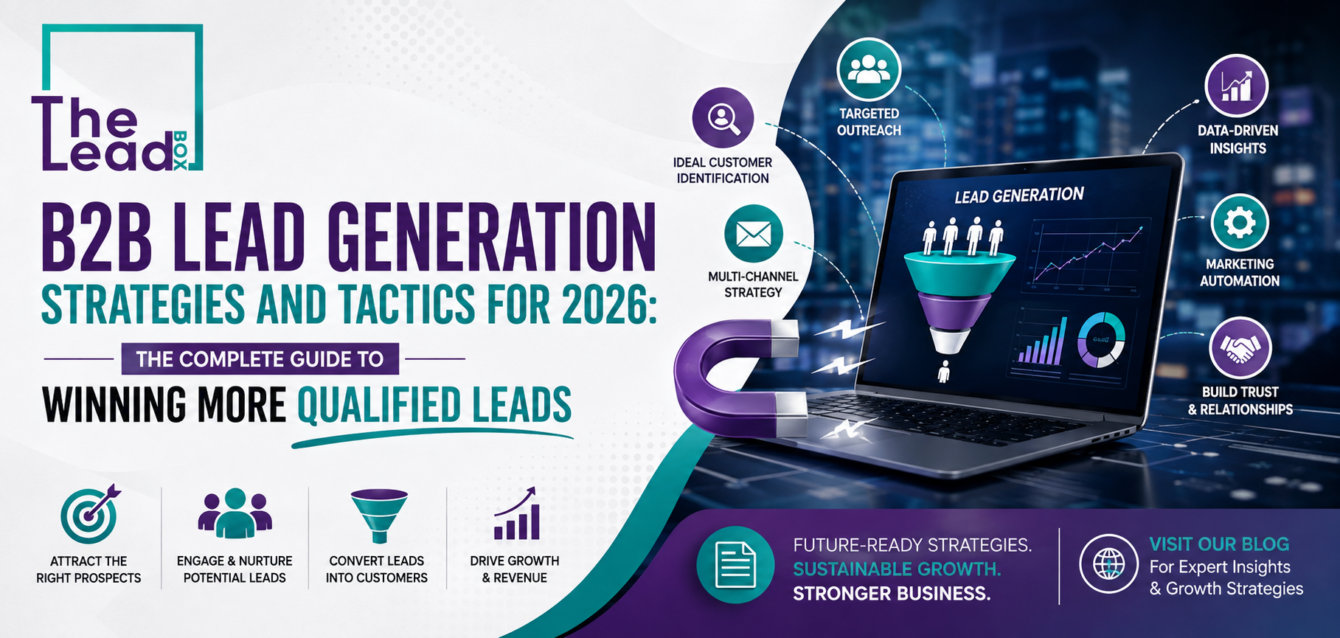
B2B lead generation is changing rapidly in 2026. Buyers are using search engines, LinkedIn, websites, AI tools, review platforms, webinars, email, and sales conversations before deciding which company to trust. For businesses, this means generating a large number of contacts is no longer enough. The real objective is to identify the right prospects, engage them with relevant messaging, qualify their intent, and turn them into sales opportunities.
According to HubSpot’s 2026 State of Marketing research, 55.7% of marketers say generating leads is easier now than it was a decade ago, while 93.8% report that their lead quality has improved over the previous year. At the same time, lead generation remains a major challenge for 30% of marketers.
This guide explains the most effective B2B lead generation strategies and tactics for 2026, including outbound marketing solutions, account-based marketing, AI-powered prospecting, content marketing, LinkedIn outreach, lead nurturing, and outsourced sales services.
What Is B2B Lead Generation in 2026?
B2B lead generation is the process of finding potential business customers and moving them toward a sales conversation or purchase.
Traditional lead generation often focused on collecting names, phone numbers, and email addresses. Modern B2B lead generation focuses much more on lead quality, buying intent, personalization, and revenue.
A successful B2B lead generation strategy typically includes:
- Identifying an ideal customer profile
- Building accurate prospect databases
- Finding relevant decision-makers
- Creating personalized messaging
- Using inbound and outbound channels
- Qualifying leads based on business needs
- Nurturing prospects over time
- Scheduling qualified sales meetings
- Tracking leads through a CRM
- Measuring pipeline and revenue contribution
The shift from lead quantity to lead quality is especially important because B2B buyers now conduct extensive independent research before contacting sales teams.
Gartner reported in 2026 that B2B buyers used an average of seven information sources during a recent purchase, while 45% said they had used generative AI during the buying process.
Why B2B Lead Generation Is More Difficult in 2026
B2B companies face several challenges when trying to generate qualified leads.
Buyers Are More Independent
Potential customers can research products, compare vendors, read reviews, study case studies, and use AI tools before speaking with a salesperson.
This means businesses need useful information available at every stage of the buying journey.
Poor Data Creates Poor Results
An outdated database can result in invalid email addresses, irrelevant contacts, incorrect job titles, and wasted sales activity.
HubSpot’s 2026 research found that only 65% of marketers say they have high-quality audience data.
Generic Outreach Does Not Stand Out
Decision-makers receive large numbers of sales emails and LinkedIn messages. A generic message that simply describes a company’s services is unlikely to generate meaningful engagement.
Modern outreach needs to explain why the offer is relevant to a particular company, industry, role, or business problem.
Marketing and Sales Alignment Is Essential
Marketing may generate thousands of leads, but if sales teams cannot identify which prospects have genuine buying intent, the pipeline becomes inefficient.
Marketing and sales teams need shared definitions for qualified leads, clear handoff processes, CRM visibility, and measurable revenue goals.
Best B2B Lead Generation Strategies for 2026
There is no single channel that works for every B2B company. The strongest strategy combines multiple channels around one clearly defined ideal customer profile.
1. Build a Strong Ideal Customer Profile
Before launching campaigns, define exactly who you want to reach.
Your ICP should include:
- Industry
- Company size
- Annual revenue
- Location
- Technology used
- Business model
- Key decision-makers
- Common pain points
- Buying triggers
- Budget range
- Sales cycle
For example, instead of targeting “software companies,” a campaign could target SaaS companies with 50 to 500 employees that are expanding into new markets and need a scalable sales development process.
Better targeting generally produces better messaging, higher relevance, and stronger sales conversations.
2. Use Data-Driven Prospect Research
High-quality prospect data is one of the foundations of successful B2B lead generation.
Businesses should research:
- Company information
- Decision-maker roles
- Professional profiles
- Business expansion
- Hiring activity
- Technology adoption
- Recent funding
- New product launches
- Geographic expansion
- Existing business challenges
The goal is not simply to create a large database. The goal is to create a database containing prospects who have a logical reason to consider your solution.
3. Invest in Personalized Outbound Marketing Solutions
Outbound marketing remains highly effective when it is targeted and personalized.
Modern outbound marketing solutions can combine:
- Cold email
- LinkedIn outreach
- Account-based marketing
- Sales development
- Prospect research
- Follow-up campaigns
- Retargeting
- Personalized landing pages
- Appointment setting
Instead of sending one message to thousands of prospects, businesses can segment prospects according to their industry, job role, business problem, and buying stage.
A strong outbound message should answer three questions quickly:
- Why are you contacting me?
- What problem can you solve?
- Why should I respond now?
4. Use Account-Based Marketing
Account-Based Marketing, or ABM, focuses marketing and sales resources on specific high-value companies.
ABM works particularly well for businesses with:
- High-value products
- Long sales cycles
- Enterprise customers
- Complex purchasing decisions
- Multiple stakeholders
For example, a company selling enterprise ERP software could identify 100 target organizations and create personalized campaigns for CEOs, CFOs, IT heads, operations leaders, and procurement teams.
5. Strengthen LinkedIn Lead Generation
LinkedIn remains an important platform for B2B prospecting because professionals can be targeted based on company, industry, job title, location, and other business characteristics.
A strong LinkedIn strategy can include:
- Optimizing executive profiles
- Publishing educational content
- Connecting with decision-makers
- Sharing case studies
- Engaging with target accounts
- Sending personalized messages
- Running LinkedIn advertising
- Retargeting engaged visitors
The objective should not be to immediately sell to every connection. Build credibility first and create relevant conversations.
6. Create Content That Captures Buying Intent
Content marketing supports both SEO and sales.
Instead of publishing content only around broad informational keywords, businesses should create content around commercial and transactional search intent.
Examples include:
- Best B2B lead generation agency
- B2B lead generation services
- Outsourced sales services
- Outbound marketing solutions
- B2B appointment setting services
- Lead generation for SaaS companies
- Lead generation for technology companies
- How to generate qualified B2B leads
- B2B sales outsourcing companies
High-intent content can attract prospects who are already researching potential solutions.
7. Use AI and Automation Without Losing the Human Element
AI can make prospecting and marketing more efficient, but automation should not replace human judgment.
AI can support:
- Prospect research
- Lead scoring
- Email personalization
- Content creation
- Customer segmentation
- Intent analysis
- Sales forecasting
- CRM data management
- Follow-up automation
However, human review remains important. Poorly personalized AI-generated messages can damage brand reputation and reduce response rates.
HubSpot’s 2026 research shows that AI and automation are becoming increasingly important across marketing teams, while personalization remains an area where many companies have significant room to improve.
The Role of an Outsourced Sales Services Partner
Building an internal sales development team requires hiring, training, technology, management, data, and ongoing optimization.
Outsourced sales services can provide an alternative by giving companies access to experienced sales development resources without building every function internally.
An outsourced partner can support:
- Prospect identification
- Database development
- Cold email campaigns
- LinkedIn prospecting
- Lead qualification
- Appointment setting
- Sales follow-ups
- CRM management
- Reporting and analytics
- Pipeline development
This approach can be especially useful for startups, SaaS companies, technology businesses, professional services firms, and organizations entering new markets.
The right partner should focus on qualified opportunities rather than simply delivering a large spreadsheet of contacts.
How The Lead Box Helps Companies Generate Qualified Leads
The Lead Box positions itself as a B2B growth partner combining marketing and sales support rather than functioning only as a traditional lead-generation vendor. Its services include B2B lead generation, outbound marketing, LinkedIn outreach, account-based marketing, email outreach, lead nurturing, and outsourced sales services.
The company’s approach includes data research, multi-channel outreach, personalized engagement, CRM integration, campaign dashboards, lead qualification, and nurturing. It states that it serves sectors including technology, SaaS, consulting, manufacturing, and professional services.
For businesses evaluating the best lead generation agency, important selection criteria should include:
- Understanding of the target industry
- Quality of prospect data
- Personalized outreach capability
- Multi-channel campaign execution
- Lead qualification process
- CRM integration
- Transparent reporting
- Sales and marketing alignment
- Ability to scale campaigns
- Focus on qualified pipeline rather than lead volume
The Lead Box’s service model is designed around these areas, making it relevant for companies looking for integrated B2B marketing and sales support.
Key B2B Lead Generation Trends for 2026
AI-Powered Prospecting
AI is becoming increasingly useful for identifying prospects, analyzing intent signals, personalizing messaging, and automating repetitive sales tasks.
Human-Led AI Marketing
AI can improve efficiency, but buyers still need trust, expertise, and human interaction. Gartner found that 69% of B2B buyers prefer to validate AI-generated insights with sales representatives.
More Focus on Lead Quality
Businesses are increasingly measuring qualified meetings, opportunities, pipeline, conversion rates, and revenue instead of only measuring the number of leads generated.
Personalization at Scale
Personalized content and outreach are becoming essential as prospects become more resistant to generic campaigns.
Multi-Channel Engagement
The strongest campaigns increasingly connect email, LinkedIn, content, SEO, paid advertising, retargeting, webinars, and sales conversations.
First-Party and High-Quality Data
As data quality becomes a bigger competitive factor, businesses need reliable databases, proper segmentation, CRM hygiene, and accurate customer information.
How to Measure B2B Lead Generation Performance
Generating leads without measuring business impact makes optimization difficult.
Track metrics such as:
- Marketing qualified leads
- Sales qualified leads
- Qualified meetings
- Lead-to-meeting conversion rate
- Meeting-to-opportunity conversion rate
- Opportunity-to-customer conversion rate
- Cost per qualified lead
- Customer acquisition cost
- Sales pipeline generated
- Revenue generated
- Return on marketing investment
- Email response rate
- LinkedIn engagement
- Website conversion rate
The most important question is not “How many leads did we generate?”
The better question is “How many qualified opportunities and how much revenue did our lead generation program create?”
Future Outlook for B2B Lead Generation
The future of B2B lead generation will combine artificial intelligence, accurate data, personalized content, automation, and human sales expertise.
B2B buyers will continue to use AI and digital channels to research potential suppliers. However, sales teams will remain important when buyers need validation, complex explanations, customization, negotiation, and confidence before making a purchase.
Companies that combine SEO, content, outbound marketing solutions, ABM, LinkedIn outreach, AI-assisted prospecting, and outsourced sales services will be better positioned to build predictable sales pipelines.
The competitive advantage will not come from sending more messages. It will come from reaching the right accounts with the right message at the right time.
Conclusion
B2B lead generation in 2026 is no longer about collecting as many contacts as possible. It is about creating a predictable system that identifies the right prospects, understands their problems, communicates relevant value, and moves qualified opportunities toward sales.
A successful strategy should combine accurate prospect data, SEO, content marketing, LinkedIn outreach, account-based marketing, personalized outbound marketing solutions, AI-powered automation, lead nurturing, and measurable sales processes.
For companies that do not want to build every sales and marketing function internally, outsourced sales services can provide experienced resources and scalable execution.
Choosing the best lead generation agency also requires looking beyond lead volume. Businesses should evaluate data quality, targeting, personalization, qualification, reporting, CRM integration, industry expertise, and the agency’s ability to contribute to actual pipeline growth.
For organizations seeking an integrated approach to B2B lead generation and sales support, The Lead Box provides services covering lead generation, outbound marketing, LinkedIn outreach, ABM, lead nurturing, and outsourced sales support.
The companies that win in 2026 will be those that stop treating lead generation as a single marketing activity and start treating it as a complete revenue-generation system.
Frequently Asked Questions About B2B Lead Generation
What is the best B2B lead generation strategy for 2026?
The best strategy depends on the target market, product, sales cycle, and customer profile. In most cases, a combination of SEO, high-intent content, LinkedIn outreach, personalized outbound marketing solutions, ABM, lead nurturing, and sales development produces a stronger pipeline than relying on one channel.
What does a B2B lead generation agency do?
A B2B lead generation agency helps businesses identify potential customers, research decision-makers, create prospect databases, run marketing campaigns, qualify leads, nurture prospects, and generate sales meetings.
How can I choose the best lead generation agency?
Look for an agency with experience in your industry, reliable prospect data, personalized outreach, multi-channel capabilities, CRM integration, transparent reporting, lead qualification processes, and a clear focus on qualified opportunities and revenue.
What are outbound marketing solutions?
Outbound marketing solutions are proactive strategies used to reach potential customers rather than waiting for them to discover a company. They can include cold email, LinkedIn outreach, account-based marketing, prospecting, direct outreach, retargeting, and appointment setting.
Are outsourced sales services suitable for small businesses?
Yes. Outsourced sales services can be useful for startups and small businesses that need sales development expertise but do not have the resources to build a complete internal sales team.
How does AI improve B2B lead generation?
AI can help with prospect research, lead scoring, customer segmentation, personalization, content creation, intent analysis, automation, and sales forecasting. Human oversight is still important to maintain accuracy, relevance, and authentic communication.
What is a qualified B2B lead?
A qualified B2B lead is a prospect that matches the company’s ideal customer profile and has a relevant business need, sufficient potential value, appropriate authority or access to decision-makers, and reasonable buying potential.
How long does B2B lead generation take?
The timeline varies by industry, target audience, offer, sales cycle, database quality, and campaign maturity. Some campaigns can generate conversations within weeks, while complex B2B sales programs may require several months of consistent prospecting and nurturing.
Why is lead quality more important than lead quantity?
A large database does not automatically create revenue. Qualified leads have a stronger connection to the ideal customer profile and are more likely to become meetings, opportunities, and customers. Focusing on quality helps sales teams spend more time with prospects who have genuine potential.
Can The Lead Box manage B2B lead generation and sales activities?
Yes. The Lead Box states that it provides integrated marketing and sales support covering lead generation, LinkedIn outreach, account-based marketing, email outreach, lead nurturing, qualified appointment setting, and outsourced sales services.
What industries can use B2B lead generation services?
B2B lead generation can be used across SaaS, technology, consulting, manufacturing, professional services, IT services, financial services, education, healthcare, logistics, and many other industries. The Lead Box specifically states that it works with technology, SaaS, consulting, manufacturing, and professional services businesses.