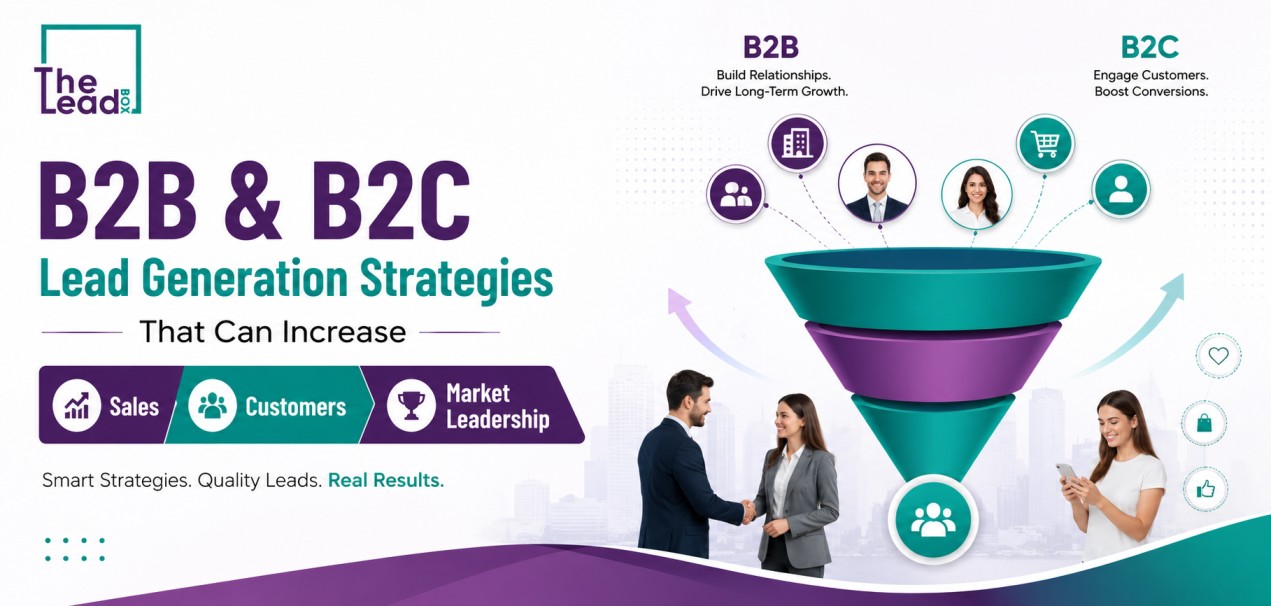
Lead generation is no longer simply about collecting names, phone numbers or email addresses. Businesses today need to identify the right prospects, understand their buying intent, reach them at the right moment and move them toward a purchase. This is especially important because modern buyers often research companies independently before they speak with a sales team.
For businesses looking to increase revenue, choosing the right Best Lead Generation Agency can make a significant difference. A professional agency can combine search marketing, paid advertising, content, social media, data intelligence, account-based marketing and event-driven campaigns to create a consistent pipeline of qualified opportunities.
For B2B companies, this approach becomes even more important. Research from 6sense found that B2B buyers increasingly form preferences before engaging sellers, while Gartner reported that 61% of B2B buyers prefer an overall rep-free buying experience.
The Lead Box helps businesses address this changing environment through B2B and B2C lead generation strategies designed to identify, engage and convert prospects.
Why Modern Businesses Need a Better Lead Generation Strategy
Traditional lead generation often focuses on reaching as many people as possible. However, a high number of unqualified leads does not necessarily produce higher revenue.
The real objective is to connect marketing activity with genuine buying intent.
A modern lead generation strategy should help businesses:
- Identify the right target audience
- Understand customer needs and buying intent
- Generate qualified leads instead of random enquiries
- Build awareness before customers contact sales
- Shorten the sales cycle
- Improve conversion rates
- Reduce wasted advertising expenditure
- Create measurable revenue opportunities
- Build long-term market leadership
This is particularly important for B2B businesses because buyers can research products, suppliers, pricing, reviews and alternatives before speaking with a salesperson.
A 2025 6sense study of more than 4,000 B2B buyers found that buyers were contacting sellers earlier than in previous years, but most of the buying journey still happened before direct sales engagement. The study also found that the vendor buyers preferred before contacting sellers won approximately 80% of the time.
This means businesses need to influence customers before the final sales conversation.
B2B Lead Generation Strategies That Increase Sales
B2B lead generation requires a different approach from consumer marketing because purchasing decisions can involve multiple stakeholders, longer sales cycles and detailed evaluation.
A successful b2b lead generation agency should therefore focus on identifying companies and decision-makers that have a genuine business need.
Account-Based Lead Generation
Account-based marketing, or ABM, focuses marketing and sales resources on specific companies rather than targeting an entire market.
For example, an ERP provider may identify manufacturing companies with outdated systems, multiple production locations or growing operational requirements.
ABM campaigns can then target:
- CEOs
- Founders
- CFOs
- CIOs
- Procurement managers
- Operations heads
- IT managers
The advantage is greater relevance. Instead of sending generic messages to thousands of prospects, businesses can create personalized campaigns for accounts with higher commercial potential.
Intent-Based Lead Generation
Intent data can help identify prospects that are actively researching a product, service or solution.
Relevant signals may include:
- Searches for commercial keywords
- Visits to product or service pages
- Downloads of technical resources
- Repeated website visits
- Pricing-page activity
- Webinar registrations
- Event participation
- Engagement with comparison content
This approach allows sales teams to prioritize prospects who are closer to making a purchase.
SEO and Content Marketing
Search visibility remains important because potential customers often begin their research online.
A strong B2B SEO strategy should target different stages of the buying funnel.
Top-of-funnel content can answer educational questions.
Middle-of-funnel content can explain solutions, comparisons and use cases.
Bottom-of-funnel content can target commercial searches such as:
- Best ERP software for manufacturers
- B2B lead generation services
- Lead generation company for SaaS
- Enterprise digital marketing agency
- Best lead generation agency in India
This creates multiple opportunities to capture prospects before they reach competitors.
LinkedIn and Social Selling
LinkedIn can be particularly valuable for B2B businesses because decision-makers, founders and professionals actively use the platform for business research and networking.
Effective campaigns can combine:
- LinkedIn advertising
- Decision-maker targeting
- Thought leadership
- Lead forms
- Personalized outreach
- Retargeting
- Industry-specific content
However, irrelevant outreach can damage results. Gartner reported that 73% of B2B buyers actively avoid suppliers that send irrelevant outreach.
The objective should therefore be relevance rather than message volume.
B2B Event Solutions
Events can generate high-quality opportunities when they are integrated with the wider marketing and sales process.
B2B Event Solutions can include:
- Trade show lead generation
- Conference marketing
- Event registration campaigns
- Delegate acquisition
- Appointment scheduling
- Exhibitor lead capture
- Pre-event outreach
- Event-based content
- Post-event lead nurturing
- Sales follow-up
The most effective approach is to treat an event as a complete lead-generation campaign rather than a single-day activity.
Before the event, businesses can identify target accounts and invite relevant decision-makers.
During the event, teams can capture engagement and qualification data.
After the event, prospects can enter personalized nurturing campaigns.
B2C Lead Generation Strategies That Increase Customers
B2C customers usually make decisions faster than B2B buyers, but they are also exposed to a large number of competing advertisements and offers.
The challenge is therefore to capture attention quickly and provide a clear reason to take action.
Search and Paid Advertising
Google Ads, social advertising and other performance marketing channels can capture customers actively searching for products or services.
Campaigns should be structured around:
- High-intent keywords
- Location
- Demographics
- Customer interests
- Previous website activity
- Purchase behavior
- Lookalike audiences
Landing pages should match the advertising message and provide a simple conversion path.
Social Media Lead Generation
Social media can generate demand through short-form videos, educational content, testimonials, offers and interactive campaigns.
HubSpot’s marketing research shows that social media remains an important product discovery channel, particularly among younger consumer groups. Its research also found that many marketers are increasingly using AI for content creation, research and data analysis.
For B2C brands, effective campaigns can combine organic social media with paid advertising and retargeting.
Retargeting and Lead Nurturing
Many visitors will not purchase during their first interaction.
Retargeting helps businesses reconnect with people who have:
- Visited the website
- Viewed a product
- Added an item to a cart
- Submitted partial information
- Engaged with social content
- Watched promotional videos
Instead of repeatedly showing the same advertisement, businesses can create sequential messages based on customer behavior.
How The Lead Box Builds a Stronger Lead Generation Pipeline
The Lead Box can position lead generation as a complete customer acquisition process rather than an isolated marketing activity.
A structured process can include:
- Audience research and segmentation
- Market and competitor analysis
- Customer persona development
- Intent and behavioral analysis
- Campaign strategy
- Content and landing-page development
- Search and paid-media campaigns
- B2B database and account targeting
- B2B Event Solutions
- Lead qualification
- CRM integration
- Lead nurturing
- Sales handover
- Performance measurement
- Continuous optimization
This approach helps connect marketing activity with actual business outcomes.
Data-Driven Lead Generation and AI Trends
Lead generation is becoming increasingly data-driven.
Businesses now have access to information from websites, advertising platforms, CRM systems, social media, search behavior and customer interactions.
The challenge is turning this information into useful decisions.
HubSpot’s 2025 marketing research found that only about one in five marketers surveyed said their marketing data was fully integrated with the tools they use. The same research highlighted data-driven decision-making and ROI measurement as major priorities.
AI is also changing how buyers discover suppliers.
A 2025 B2B buyer study from Responsive reported that 90% of buyers conduct research before contacting a vendor and that GenAI is increasingly becoming part of the research process.
This creates an important opportunity for businesses.
Companies should create content that clearly answers customer questions, demonstrates expertise, provides original insights and makes important information easy for search engines and AI systems to understand.
Important Lead Generation KPIs
Businesses should measure more than the number of leads generated.
Important metrics include:
- Marketing qualified leads
- Sales qualified leads
- Cost per lead
- Cost per qualified lead
- Lead-to-customer conversion rate
- Customer acquisition cost
- Sales pipeline value
- Return on advertising spend
- Revenue generated
- Sales cycle length
- Customer lifetime value
These metrics help identify which channels are producing real business value.
Industry Applications
A professional Best Lead Generation Agency can adapt its strategy to different industries.
For SaaS companies, the focus may be demo requests, free trials, account targeting and product-led content.
For manufacturing companies, campaigns can focus on decision-makers, technical requirements, distributors and procurement teams.
For healthcare and professional services, trust, credibility and educational content can become major conversion factors.
For education companies, lead generation can focus on course searches, student intent, counselling enquiries and remarketing.
For real estate companies, location-based targeting, property intent and lead nurturing can help increase qualified enquiries.
For retail and consumer businesses, social media, paid search, promotions, remarketing and customer data can support faster conversions.
Future of B2B and B2C Lead Generation
The future of lead generation will be increasingly connected to AI, first-party data, personalization, intent signals and omnichannel customer journeys.
B2B buyers are already becoming more independent. Gartner’s research shows a strong preference for rep-free buying experiences, while 6sense research indicates that buyers often establish preferences before speaking to sales teams.
This means companies cannot wait until a prospect fills out a contact form.
They need to build visibility earlier.
The businesses most likely to achieve market leadership will be those that combine:
- Strong search visibility
- Useful educational content
- AI-ready information
- Intent-based targeting
- Personalized campaigns
- Paid media
- Social selling
- Events
- CRM data
- Sales and marketing alignment
- Continuous performance analysis
Why Choose The Lead Box
Choosing a lead generation partner should not be based only on the number of leads promised.
Businesses should evaluate whether the agency understands their market, customer journey and revenue objectives.
The Lead Box can differentiate its approach by focusing on contextual lead generation, customer intent and measurable business outcomes.
The key benefits can include:
- B2B and B2C lead generation expertise
- Targeted customer identification
- Intent-based prospecting
- Performance marketing
- SEO and content-led demand generation
- Account-based marketing
- B2B Event Solutions
- Lead qualification
- Lead nurturing
- Data-driven optimization
- Conversion-focused campaigns
The ultimate goal is not simply to generate more enquiries. It is to generate better opportunities that can become customers, increase revenue and strengthen market position.
Conclusion
Successful lead generation has moved beyond mass advertising and generic prospecting. Modern customers research independently, compare alternatives and expect businesses to understand their needs before starting a sales conversation.
For B2B organizations, this makes intent data, ABM, SEO, content marketing, social selling and B2B Event Solutions increasingly valuable. For B2C brands, paid advertising, social media, personalization, retargeting and conversion-focused campaigns can help turn attention into customers.
Working with the right b2b lead generation agency can help businesses build a predictable pipeline instead of relying on inconsistent enquiries.
The Lead Box can help businesses combine B2B and B2C strategies into a measurable lead generation system designed around customer intent, qualification, conversion and growth.
The businesses that identify potential customers earlier, communicate relevant value and use data to continuously improve their campaigns will be better positioned to increase sales, acquire customers and build long-term market leadership.
Frequently Asked Questions
What is a lead generation agency?
A lead generation agency helps businesses identify potential customers, attract prospects, qualify opportunities and support the sales process through channels such as SEO, paid advertising, content marketing, social media, account-based marketing, events and data-driven campaigns.
What does a B2B lead generation agency do?
A b2b lead generation agency identifies potential business customers and decision-makers, develops targeted campaigns and helps generate qualified sales opportunities. The process can include account-based marketing, intent targeting, LinkedIn campaigns, content marketing, outbound prospecting, event campaigns and lead nurturing.
What is the difference between B2B and B2C lead generation?
B2B lead generation generally targets businesses and professional decision-makers, often involving longer sales cycles and multiple stakeholders. B2C lead generation targets individual consumers and often focuses on faster purchasing decisions, offers, social media, paid advertising and remarketing.
How can lead generation increase sales?
Lead generation increases sales by identifying potential customers, attracting them with relevant information or offers, qualifying their interest and moving them toward a purchase. Better targeting can also reduce wasted marketing expenditure and improve conversion efficiency.
What are B2B Event Solutions?
B2B Event Solutions are services designed to generate and manage business leads through conferences, trade shows, exhibitions and other professional events. They can include pre-event promotion, attendee acquisition, appointment setting, lead capture, qualification and post-event nurturing.
Why is intent data important for lead generation?
Intent data provides signals that can indicate when a potential customer is researching a product or service. Businesses can use these signals to prioritize prospects and deliver more relevant marketing or sales communication.
How does AI affect lead generation?
AI can help businesses analyze customer data, identify patterns, personalize campaigns, automate workflows, create content and support prospect research. However, human review, accurate data and strategic decision-making remain important.
HubSpot’s 2025 research found that AI is already being used by marketers for content creation, research, data analysis and workflow-related activities.
How can a business choose the Best Lead Generation Agency?
Businesses should evaluate an agency based on its understanding of the target market, lead qualification process, technology, reporting, conversion strategy, industry experience and ability to connect marketing activity with revenue.
How long does B2B lead generation take to produce results?
The timeframe varies according to industry, target market, sales cycle, competition, campaign budget and existing brand visibility. SEO and content strategies can require longer-term investment, while paid campaigns and targeted outbound programs can produce opportunities more quickly.
What should businesses measure in a lead generation campaign?
Businesses should measure qualified leads, cost per qualified lead, conversion rate, customer acquisition cost, pipeline value, revenue, return on advertising spend and sales cycle length rather than focusing only on total lead volume.
Can The Lead Box handle both B2B and B2C lead generation?
Yes. A combined approach can use different targeting, messaging, channels and conversion processes for B2B and B2C audiences while maintaining a unified focus on qualified opportunities, sales growth and market leadership.
How can lead generation help build market leadership?
Lead generation can contribute to market leadership by increasing visibility, reaching high-value prospects earlier, building authority through useful content, creating consistent sales opportunities and developing stronger relationships with target customers.