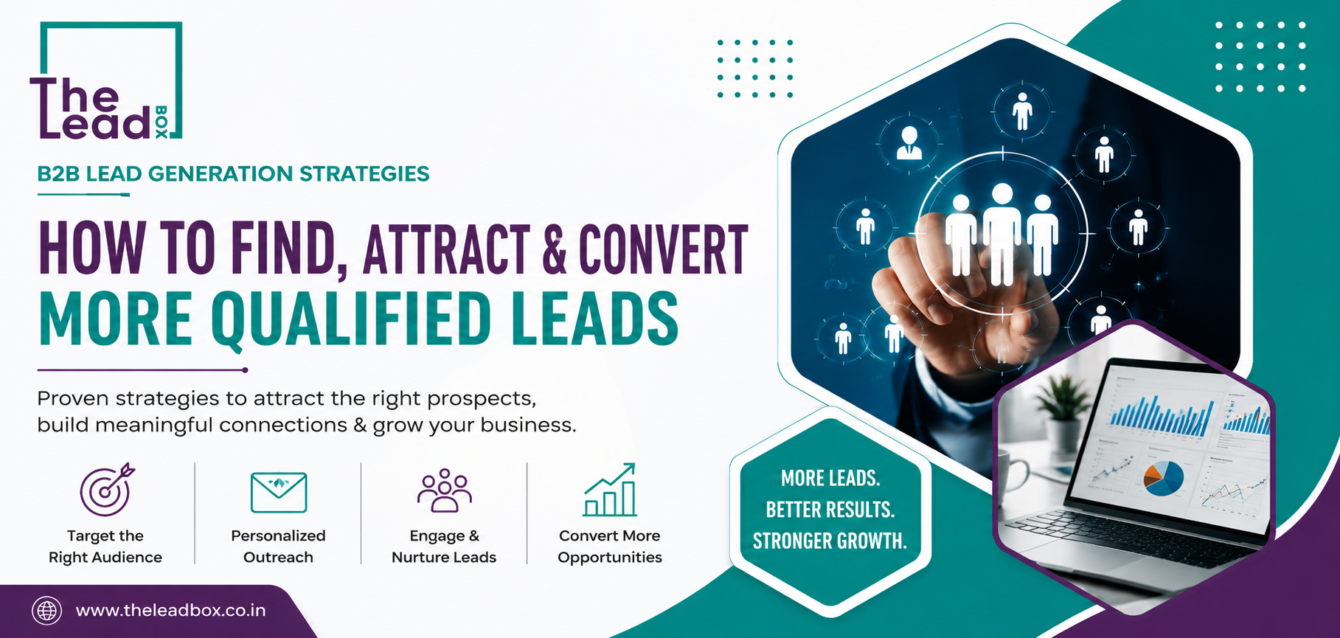
B2B companies need more than a large database of contacts to grow. They need the right prospects, meaningful conversations, and a reliable process for converting interest into sales opportunities. This is where effective B2B lead generation strategies become essential.
Finding qualified B2B leads can be challenging because decision-makers are busy, competition is high, and traditional marketing methods often produce inconsistent results. Businesses need a structured approach that combines content, email, LinkedIn, prospect research, sales outreach, and data-driven optimization.
The Lead Box helps businesses build a predictable lead generation process focused on identifying the right prospects, attracting their attention, and turning them into qualified sales opportunities. By combining strategic targeting with personalized outreach, businesses can improve lead quality and create a stronger sales pipeline.
What Is B2B Lead Generation?
B2B lead generation is the process of identifying potential business customers and encouraging them to show interest in a product or service. Unlike B2C marketing, B2B lead generation often involves longer buying cycles, multiple decision-makers, higher-value deals, and detailed research before a purchase decision.
A successful B2B lead generation strategy generally includes:
- Identifying the ideal customer profile
- Researching target companies and decision-makers
- Creating useful and relevant content
- Using email and LinkedIn outreach
- Running targeted advertising campaigns
- Qualifying prospects based on business needs
- Nurturing leads throughout the buying journey
- Measuring campaign performance and improving results
The goal is not simply to generate more leads. It is to generate qualified leads that have a genuine possibility of becoming customers.
Why B2B Businesses Struggle to Generate Qualified Leads
Many companies invest heavily in marketing but still struggle to generate consistent sales opportunities. The problem is often not a lack of effort but an ineffective lead generation process.
Some common challenges include:
Poor Audience Targeting
Marketing to everyone makes it difficult to create relevant messaging. Without a clearly defined ideal customer profile, businesses can waste time and budget reaching people who are unlikely to buy.
Low-Quality Leads
A large number of leads does not necessarily mean a successful campaign. Unqualified contacts can consume sales resources without producing meaningful opportunities.
Generic Outreach
Decision-makers receive numerous promotional emails and LinkedIn messages every day. Generic messages are easily ignored, especially when they do not address a specific business challenge.
Long B2B Sales Cycles
B2B purchases often require approval from multiple stakeholders. Prospects may need weeks or months to evaluate vendors, compare solutions, and secure budgets.
Lack of Sales and Marketing Alignment
When marketing and sales teams work separately, leads may not be followed up properly. A strong lead generation strategy requires both teams to agree on what constitutes a qualified lead and how it should be handled.
Effective B2B Lead Generation Strategies
A successful strategy combines multiple channels rather than depending on one source of leads. The right approach should match the target audience, industry, buying journey, and sales objectives.
Define Your Ideal Customer Profile
Before starting an outreach campaign, identify exactly who you want to reach.
Your ideal customer profile should consider:
- Industry
- Company size
- Location
- Revenue
- Business model
- Technology used
- Decision-maker role
- Common challenges
- Purchasing capacity
This information helps marketing teams create highly targeted campaigns instead of sending generic messages to large databases.
Build a High-Quality Prospect Database
Accurate prospect data is the foundation of successful B2B outreach. Companies should identify relevant organizations and decision-makers based on their ideal customer profile.
A strong database can include:
- Company information
- Decision-maker names
- Job titles
- Business email addresses
- LinkedIn profiles
- Industry information
- Company size
- Relevant business signals
Data should also be regularly reviewed and updated to reduce outdated contacts and improve campaign performance.
Create Valuable B2B Content
Content marketing can help businesses attract prospects before they are ready to speak with sales. Educational content answers questions, demonstrates expertise, and builds trust.
Useful content formats include:
- Industry guides
- Case studies
- Research reports
- Whitepapers
- Blog articles
- Comparison pages
- Product guides
- Webinars
- Customer success stories
For example, a technology company targeting manufacturers could publish content explaining how automation reduces production costs. The content can attract prospects experiencing the same challenge and move them closer to a sales conversation.
Use Personalized Email Outreach
Email remains an important channel for B2B prospecting when it is properly targeted and personalized.
Effective email campaigns should focus on the prospect rather than simply promoting a product.
A good outreach email can:
- Identify a relevant business challenge.
- Explain why the challenge matters.
- Introduce a possible solution.
- Provide a useful reason to respond.
- End with a simple call to action.
Personalization can include the prospect’s industry, company growth, technology stack, recent business development, or specific operational challenges.
Leverage LinkedIn for Prospecting
LinkedIn provides businesses with access to professional audiences and decision-makers. It can be used for both organic relationship building and targeted outreach.
Companies can improve LinkedIn prospecting by:
- Connecting with relevant decision-makers
- Sharing industry insights
- Commenting on relevant discussions
- Sending personalized messages
- Publishing educational content
- Using social proof and case studies
The objective should be to start relevant conversations rather than immediately push a sales pitch.
Use Outbound Marketing Solutions Strategically
Outbound marketing can accelerate the process of reaching potential customers who match specific buying criteria. Instead of waiting for prospects to discover a company, businesses can proactively approach decision-makers who are likely to need their solutions.
A well-planned outbound strategy can combine email outreach, LinkedIn prospecting, SDR calling, account research, and campaign optimization.
The Lead Box focuses on targeted outreach designed to connect businesses with relevant decision-makers. This approach can help organizations create a consistent pipeline instead of depending entirely on inbound traffic or referrals.
Qualify Leads Before Passing Them to Sales
Not every prospect should be treated as a sales-ready lead. Lead qualification helps sales teams focus their time on opportunities with higher potential.
Qualification criteria can include:
- Business need
- Company fit
- Decision-making authority
- Budget
- Purchase timeline
- Current solution
- Business urgency
Businesses can use lead scoring systems to rank prospects based on these factors.
How The Lead Box Helps Businesses Generate Better Leads
The Lead Box takes a strategic approach to B2B lead generation by focusing on audience targeting, prospect research, personalized communication, and appointment-focused campaigns.
Businesses looking for the Best Lead Generation Agency need more than a company that can deliver a spreadsheet of contacts. They need a partner that understands their target market and can help create meaningful sales conversations.
The Lead Box can support businesses with:
- Ideal customer profile development
- Target account research
- B2B database building
- Email outreach
- LinkedIn prospecting
- SDR calling
- Lead qualification
- Appointment generation
- Campaign optimization
- Performance tracking
The focus is on connecting businesses with relevant prospects rather than maximizing the number of unqualified contacts.
B2B Lead Generation Trends to Watch
The B2B lead generation landscape continues to evolve as buyers become more informed and marketing technology becomes more advanced.
Some important trends include:
AI-Assisted Prospect Research
Artificial intelligence can help businesses analyze large amounts of prospect data, identify patterns, personalize communication, and prioritize accounts.
Account-Based Marketing
ABM focuses marketing and sales resources on specific high-value accounts. Instead of targeting a broad market, businesses can create personalized campaigns for companies that have strong revenue potential.
Intent-Based Targeting
Buyer intent data can help identify organizations that are actively researching a product, service, or business problem. This allows sales teams to prioritize prospects that may be closer to making a purchasing decision.
Omnichannel Outreach
Combining email, LinkedIn, calling, content, and other channels can increase the number of opportunities to engage prospects. The key is maintaining a consistent message across channels.
Data Quality and Personalization
As inboxes become more crowded, accurate data and relevant messaging are becoming increasingly important. Personalized campaigns can make outreach more meaningful and improve engagement.
How to Improve B2B Lead Conversion Rates
Generating leads is only the beginning. Businesses also need a process for converting prospects into customers.
Start by responding quickly to qualified leads. Then provide relevant information based on their specific needs. Sales teams should avoid using the same pitch for every prospect.
Businesses should also track key performance indicators such as:
- Lead-to-meeting conversion rate
- Meeting-to-opportunity rate
- Opportunity-to-customer conversion rate
- Cost per qualified lead
- Email response rate
- Appointment rate
- Sales pipeline value
- Customer acquisition cost
These metrics help businesses identify which campaigns are producing real commercial value.
Future of B2B Lead Generation
The future of B2B lead generation will increasingly depend on data, personalization, automation, and human relationships. AI can make prospect research and campaign management more efficient, but strong communication and genuine understanding of customer problems will remain essential.
Businesses will also move toward more integrated sales and marketing systems where data flows between prospecting, marketing, CRM, sales development, and customer acquisition.
The companies that succeed will not necessarily be those that contact the most prospects. They will be the ones that identify the right accounts, understand their challenges, deliver relevant messaging, and build trust throughout the buying process.
Conclusion
Effective B2B lead generation is about quality, relevance, and consistency. Businesses need to understand their ideal customers, identify the right decision-makers, communicate their value clearly, and create a structured process for nurturing and qualifying prospects.
From targeted prospect research and personalized email campaigns to LinkedIn outreach, content marketing, AI-assisted targeting, and account-based marketing, businesses have multiple opportunities to create a stronger sales pipeline.
Choosing the right Best Lead Generation Agency can help businesses turn these strategies into a repeatable acquisition system. The Lead Box combines targeted prospecting, personalized outreach, qualification, and appointment generation to help businesses connect with more relevant decision-makers.
For companies that want predictable B2B growth, investing in a strategic lead generation process can be the difference between simply collecting contacts and consistently creating qualified sales opportunities.
Frequently Asked Questions
What is B2B lead generation?
B2B lead generation is the process of finding potential business customers, engaging them with relevant communication, and moving qualified prospects toward a sales conversation or purchase.
What are the most effective B2B lead generation strategies?
Some of the most effective strategies include ideal customer profiling, targeted prospecting, personalized email outreach, LinkedIn prospecting, content marketing, account-based marketing, lead nurturing, and sales qualification.
How can I generate more qualified B2B leads?
Start by defining your ideal customer profile and targeting companies that match it. Use accurate prospect data, personalized messaging, relevant content, and consistent follow-up. Lead qualification should then be used to identify prospects with genuine buying potential.
Is cold email still effective for B2B lead generation?
Yes. Cold email can be effective when it is targeted, personalized, relevant, and compliant with applicable email marketing requirements. Generic mass emails are generally less effective than well-researched outreach.
How does LinkedIn help with B2B lead generation?
LinkedIn helps businesses identify decision-makers, build professional relationships, share industry expertise, and start conversations with prospects who fit their target audience.
What is the difference between lead generation and lead qualification?
Lead generation focuses on finding and attracting potential customers. Lead qualification evaluates those prospects to determine whether they match the company’s target profile and have genuine potential to become customers.
How can AI improve B2B lead generation?
AI can support prospect research, data analysis, lead scoring, personalization, content creation, and campaign optimization. Human oversight remains important for strategy, communication quality, and relationship building.
What should businesses look for in a B2B lead generation agency?
Businesses should consider an agency’s experience, targeting methodology, data quality, personalization capabilities, communication channels, lead qualification process, reporting, and ability to generate measurable sales opportunities.
How long does B2B lead generation take?
The timeline depends on the industry, target audience, offer, sales cycle, database quality, and campaign strategy. Some campaigns can generate conversations within weeks, while complex B2B sales processes may require longer-term nurturing.
Why choose The Lead Box for B2B lead generation?
The Lead Box focuses on targeted prospecting, personalized outreach, lead qualification, and appointment generation. Its approach is designed to help businesses connect with relevant decision-makers and build a more consistent B2B sales pipeline.